

By using the libraries available in Write Studio—terminology, bookmarks, prompts, and references—academic authors can construct a personal research knowledge base that feeds directly into AI-assisted workflows. The result is a more controlled, transparent, and reusable approach to working with generative AI in academic research.

The growing adoption of AI-assisted research tools has created a new challenge for academic authors: how to control the sources used by generative systems. Tools such as NotebookLM allow researchers to ground AI outputs in curated documents rather than relying on the model’s general training data. This capability is particularly valuable for scholarly work, where traceability and citation integrity are essential.
However, the effectiveness of such tools depends on the quality and organisation of the source materials provided. One emerging solution is to maintain reusable knowledge libraries that can be supplied as structured source content to AI systems.
Platforms such as Write Studio provide reusable libraries for terminology, bookmarks, prompts, and references, allowing researchers to maintain a curated knowledge base that can be used across writing projects. When these libraries are combined with NotebookLM, they create a powerful workflow for academic research and writing.
This article explains how academic authors can use reusable libraries as source corpora for AI-assisted research.
A key feature of NotebookLM is its source-grounded generation model. Instead of producing answers solely from a pretrained language model, it generates responses based on documents uploaded by the user.
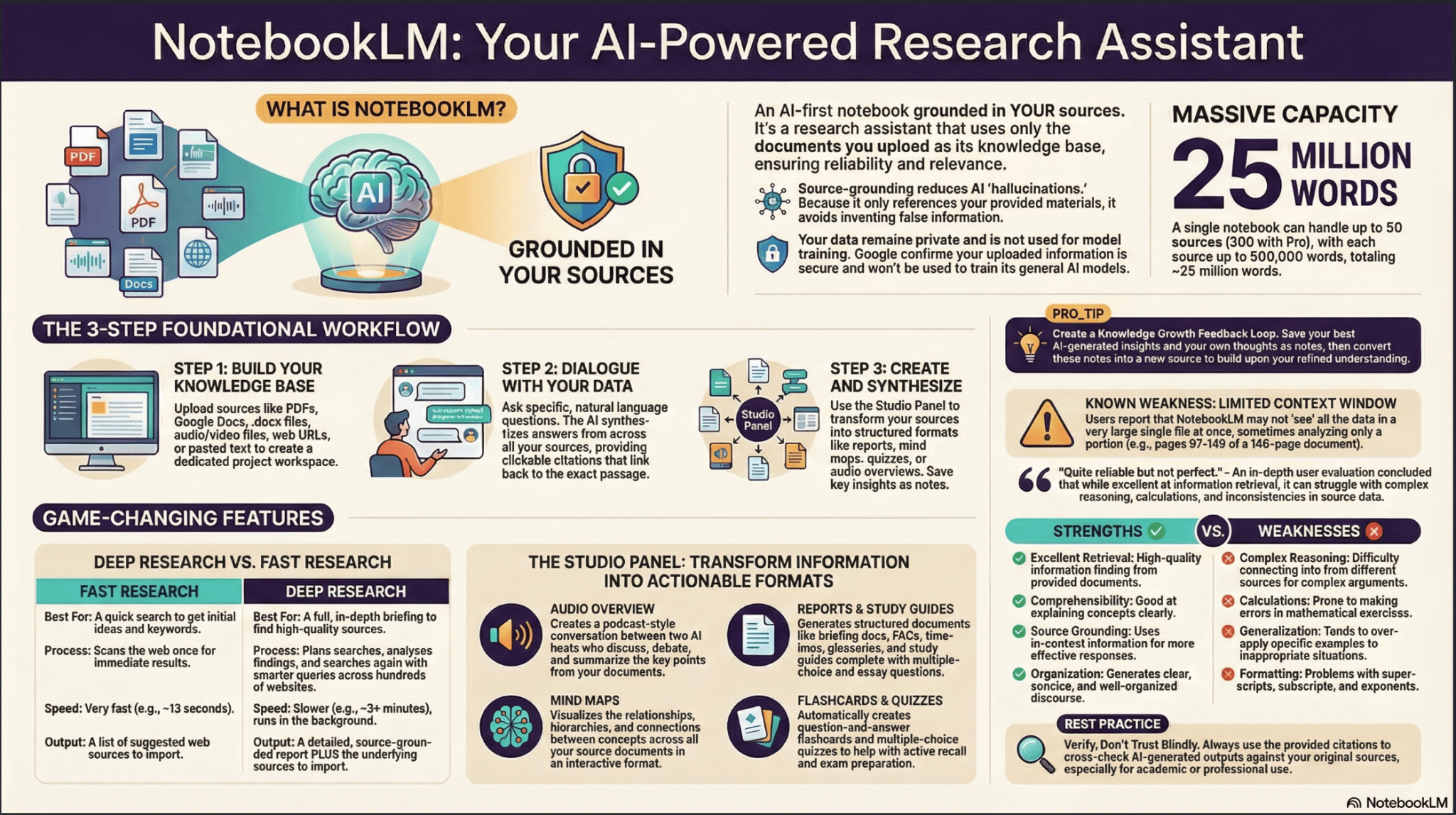
This design helps address several issues relevant to academic work:
In effect, NotebookLM functions as a contextual research assistant, drawing only on the materials the researcher supplies.
For this reason, the quality of the source library becomes critical.
Academic authors routinely accumulate research assets:
Unfortunately, these materials are often scattered across documents, browser bookmarks, and note-taking systems. Reusable libraries consolidate these resources into structured knowledge components that can be reused across projects.
Write Studio provides four key reusable library types:
When exported or copied into NotebookLM, these libraries form a high-quality curated source corpus.
Terminology libraries capture standardised concept definitions, preferred terms, and related metadata.
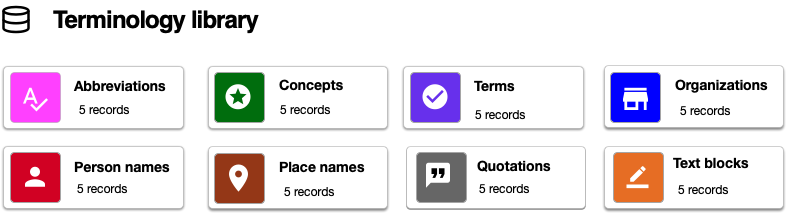
In terminology science, concepts are defined independently of the terms used to express them (ISO, 2019). Maintaining a personal terminology library therefore allows researchers to ensure consistent conceptual definitions across publications.
A terminology library may include:
When a terminology library is added as a source document, NotebookLM can:
For example, a researcher working in information science could upload a terminology export containing definitions for:
NotebookLM can then generate explanations or summaries using these definitions as authoritative sources.
Academic researchers rely heavily on web-based resources such as standards bodies, policy documents, and digital archives. A bookmark library captures curated links with descriptive annotations.
---image bookmark libraries
A structured bookmark entry typically includes:
Examples of useful bookmarked sources might include:
Researchers can convert bookmark libraries into annotated reading lists and upload them as source documents.
NotebookLM can then:
This approach effectively transforms a bookmark collection into a machine-readable research corpus.
Prompt libraries store reusable instructions for AI systems.
---image
Academic prompt templates may include tasks such as:
When stored in a library, prompts can be reused across multiple research sessions.
Researchers can paste prompt templates directly into NotebookLM when querying source materials. This produces consistent analytical outputs across different projects.
For example, a literature analysis prompt might specify:
Using a prompt library ensures that the same analytical method is applied repeatedly, improving research consistency.
Reference libraries capture bibliographic records that can later be used for citations.
---image
Typical reference metadata includes:
Maintaining references in a structured library allows researchers to maintain citation-ready source material.
When reference lists are uploaded as sources, NotebookLM can:
This reduces the risk of AI-generated text referencing sources that the researcher has not verified.
The combination of reusable libraries and NotebookLM enables a structured AI-assisted research workflow.
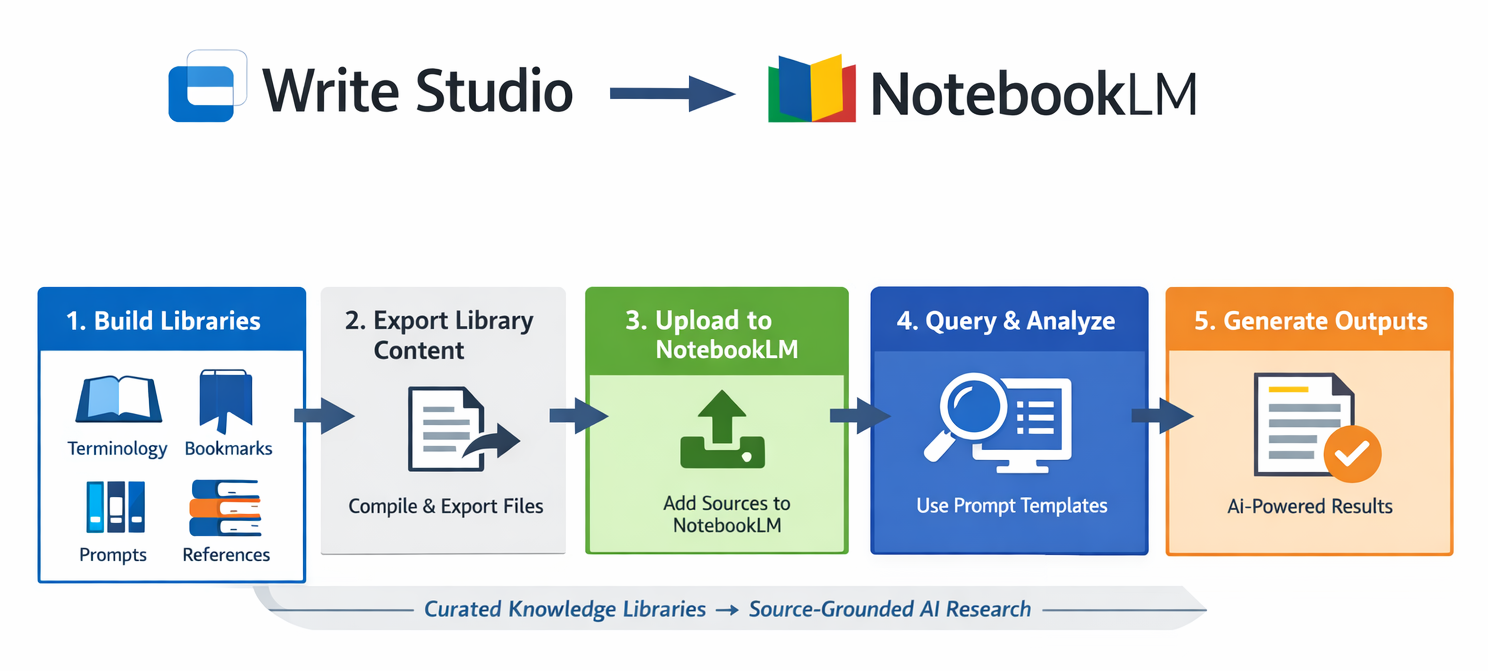
Step 1 — Capture knowledge
Use Write Studio libraries to capture:
Step 2 — Export library content
Export or compile relevant library entries into a research document.
Step 3 — Upload sources to NotebookLM
Add the exported material as source documents.
Step 4 — Query using structured prompts
Use prompt templates to analyse the source material.
Step 5 — Generate grounded outputs
NotebookLM produces responses tied directly to the uploaded knowledge sources.
Step 6— Finess outputs into publishable form
Transfering AI output into an academic writing tool enables finer analysis of logic, order, and depth of argument based on the individuals preferred styles and resrch aims.
Using reusable libraries as AI source material offers several advantages.
AI tools such as NotebookLM are most valuable when they operate on high-quality, researcher-curated sources. Maintaining reusable knowledge libraries provides a systematic way to build such sources over time.
By using the libraries available in Write Studio—terminology, bookmarks, prompts, and references—academic authors can construct a personal research knowledge base that feeds directly into AI-assisted workflows.
The result is a more controlled, transparent, and reusable approach to working with generative AI in academic research.
Bommasani, R. et al. (2021) On the opportunities and risks of foundation models. Stanford Center for Research on Foundation Models.
ISO (2019) ISO 704: Terminology work — Principles and methods. Geneva: International Organization for Standardization.
Knaflic, C. (2015) Storytelling with Data. Hoboken: Wiley.
Google (2024) NotebookLM product documentation. Available at: https://notebooklm.google
Reynolds, L. and McDonell, K. (2021) ‘Prompt programming for large language models’, CHI EA '21: Extended Abstracts of the 2021 CHI Conference on Human Factors in Computing Systems.


.png)


