

Kanban provides dissertation writers with a practical, adaptable, and research-informed system for managing the complexities of long-form academic writing.
Doctoral dissertations are multi-year, multi-stage projects that challenge even the most organised researchers. They involve complex research tasks, iterative drafting, ongoing supervisory feedback, and extensive revision cycles. Unsurprisingly, dissertation writers frequently struggle to maintain momentum, prioritise effectively, and sustain visibility into their progress. In recent years, project-management methodologies from software development and manufacturing have been adopted by academics to address these challenges. Among them, Kanban—originating from Toyota’s production system—has proven particularly suited to research and writing workflows (Anderson 2010; Ladas 2009). This blog examines how Kanban supports dissertation writers by increasing transparency, reducing cognitive load, and enabling continuous, sustainable progress.
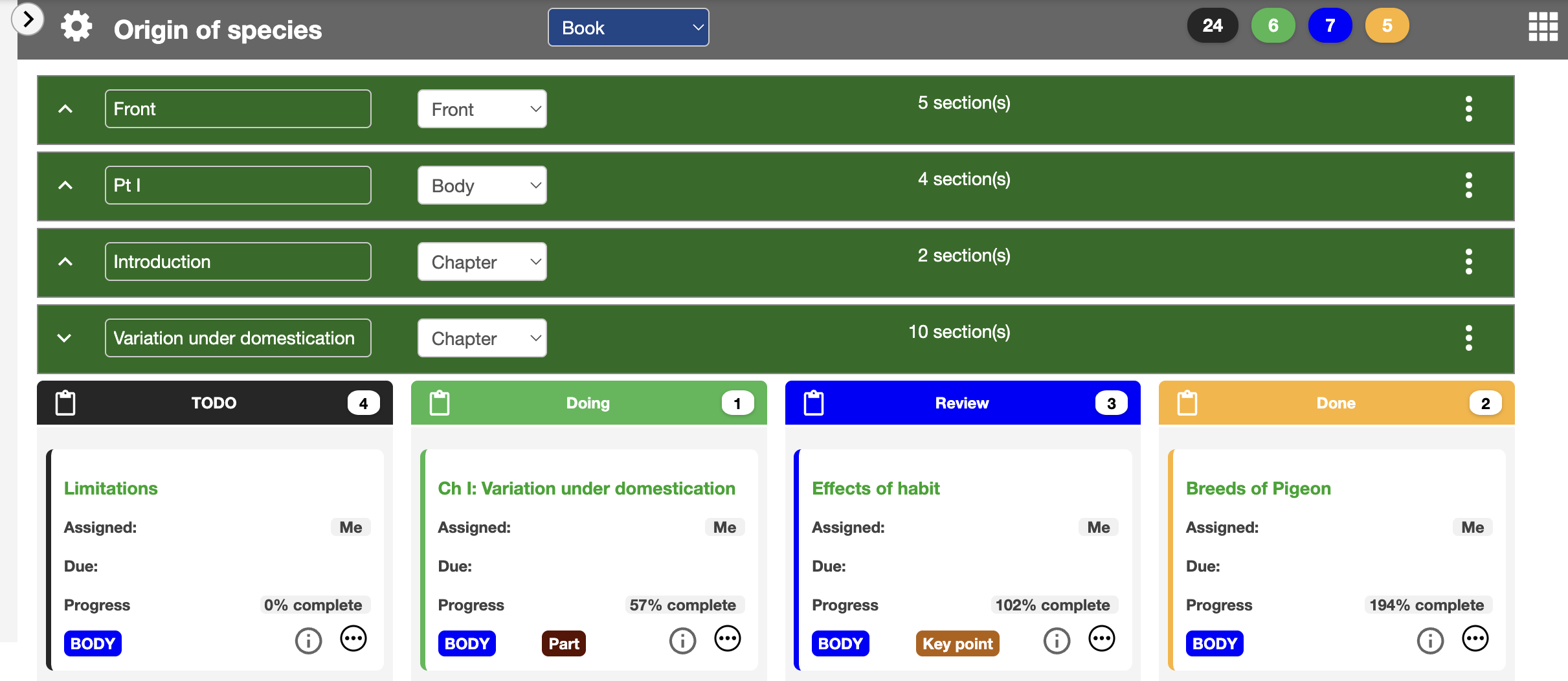
Kanban is fundamentally a visual method for managing work-in-progress. A typical Kanban board consists of columns such as “Backlog,” “In Progress,” “Waiting/Blocked,” and “Done.” Tasks are represented as cards that move from left to right as they advance. Visual management systems have been extensively studied and are known to enhance planning accuracy and reduce ambiguity in complex workflows (Modig & Åhlström 2013).
For dissertation writers, this visualisation is particularly powerful. Research in self-regulation and academic productivity suggests that externalising tasks into visible, discrete units improves goal clarity and reduces procrastination (Boice 2000; Sword 2017). When each chapter, subsection, data-analysis step, or revision task appears as a card on the board, the writer gains immediate insight into what needs to be done, what is coming next, and where bottlenecks may be forming.
Dissertation writing demands intensive cognitive effort, and doctoral candidates often report feeling overwhelmed, especially during the later stages of analysis and writing. Kanban addresses this through work-in-progress (WIP) limits—rules that restrict how many tasks can be actively undertaken at once. WIP limits reduce context-switching, which cognitive load theory identifies as a major drain on working memory resources (Sweller, Ayres & Kalyuga 2011).
By constraining the number of simultaneous tasks, writers maintain deeper focus and reduce mental fatigue. For example, setting a limit of three active tasks—such as coding qualitative data, drafting a literature review subsection, and incorporating supervisor comments—helps maintain attention and minimises the diffuse anxiety associated with attempting to advance too many tasks in parallel.
One of the most demotivating aspects of dissertation writing is the delayed visibility of final outputs. A chapter may take months to complete, during which writers often feel uncertain about whether they are progressing. Kanban offers “micro-progress visibility,” allowing writers to see incremental achievements. Studies show that perceiving small wins boosts intrinsic motivation, persistence, and overall engagement on complex tasks (Amabile & Kramer 2011).
Completed tasks remain in the “Done” column, creating a visual record of accomplishment. This positive reinforcement loop strengthens self-efficacy and helps writers maintain momentum over long research cycles.
Dissertation writing rarely follows a straightforward path. Writers move between chapters, refine arguments, conduct iterative analyses, and incorporate supervisory feedback. Kanban’s flexibility supports these non-linear processes. Its dynamic structure allows continuous reprioritisation, card movement, and task creation, aligning well with iterative academic methodologies, including qualitative coding cycles (Charmaz 2014), doctrinal legal analysis, or mixed-methods research.
The Kanban board functions as a living map of the project. It helps writers maintain strategic oversight even as individual tasks evolve, change, or recur.
Kanban also facilitates more efficient communication between dissertation writers and supervisors. Research on academic supervision emphasises that clarity of expectations and transparency of progress significantly improve supervisory relationships (Lee 2012; Guerin, Kerr & Green 2015). Supervisors can quickly identify bottlenecks, pending tasks, or persistent obstacles, enabling discussions to move from administrative status updates to substantive methodological or conceptual issues.
Write.studio is the only document processor to provide a built-in Kanban together with academic writing tools, enabling both writing and tracking to merge successfully. Other tools such as Trello, Notion, or Monday.com require management of multiple tools which adds further complexity to a difficult writing project.
Finally, Kanban supports sustainable work practices. Productivity research consistently recommends incremental progress, workload moderation, and steady engagement as foundational to long-term academic output (Boice 2000; Silvia 2019). By breaking down large tasks into smaller sections, limiting WIP, and providing continuous visibility, Kanban reduces burnout and encourages a consistent writing rhythm.
This makes Kanban especially suited to multi-year projects like dissertations, where maintaining steady progress is more productive and healthier than intermittent surges of high-intensity work.
Kanban provides dissertation writers with a practical, adaptable, and research-informed system for managing the complexities of long-form academic writing. By visualising tasks, limiting work-in-progress, supporting iterative development, and offering motivational visibility, Kanban directly addresses the pressures and ambiguities that make dissertation writing so challenging. As doctoral research becomes increasingly interdisciplinary and project-driven, methodologies such as Kanban will continue to play a vital role in fostering efficient, transparent, and sustainable academic work.
Amabile, TM & Kramer, SJ 2011, The Progress Principle: Using Small Wins to Ignite Joy, Engagement, and Creativity at Work, Harvard Business Review Press, Boston.
Anderson, DJ 2010, Kanban: Successful Evolutionary Change for Your Technology Business, Blue Hole Press, Sequim.
Boice, R 2000, Advice for New Faculty Members: Nihil Nimus, Allyn & Bacon, Boston.
Charmaz, K 2014, Constructing Grounded Theory, 2nd edn, Sage, London.
Guerin, C, Kerr, H & Green, I 2015, ‘Supervisors’ perceptions of candidate writing and the role of feedback in dissertation supervision’, Journal of University Teaching & Learning Practice, vol. 12, no. 1, pp. 1–16.
Ladas, C 2009, Scrumban: Essays on Kanban Systems for Lean Software Development, Modus Cooperandi Press, Seattle.
Lee, A 2012, ‘Successful research supervision: Advising students doing research’, Routledge, London.
Modig, N & Åhlström, P 2013, This Is Lean: Resolving the Efficiency Paradox, Rheologica Publishing, Stockholm.
Silvia, PJ 2019, How to Write a Lot: A Practical Guide to Productive Academic Writing, 2nd edn, American Psychological Association, Washington, DC.
Sweller, J, Ayres, P & Kalyuga, S 2011, Cognitive Load Theory, Springer, New York.
Sword, H 2017, Air & Light & Time & Space: How Successful Academics Write, Harvard University Press, Cambridge.


.png)


