

The literature review is a context-sensitive scholarly instrument: its aims evolve from knowledge acquisition (school) to analytical synthesis (undergraduate), to epistemic contribution (postgraduate), and finally to evidence-based application (HRD).

A literature review is a structured synthesis and critical evaluation of existing knowledge within a defined domain. Its primary function is not merely descriptive; rather, it establishes the intellectual context for inquiry, identifies knowledge gaps, and supports the formulation of research questions or decisions (Booth, Sutton & Papaioannou 2016; Snyder 2019).
At its core, a literature review serves five interrelated aims:
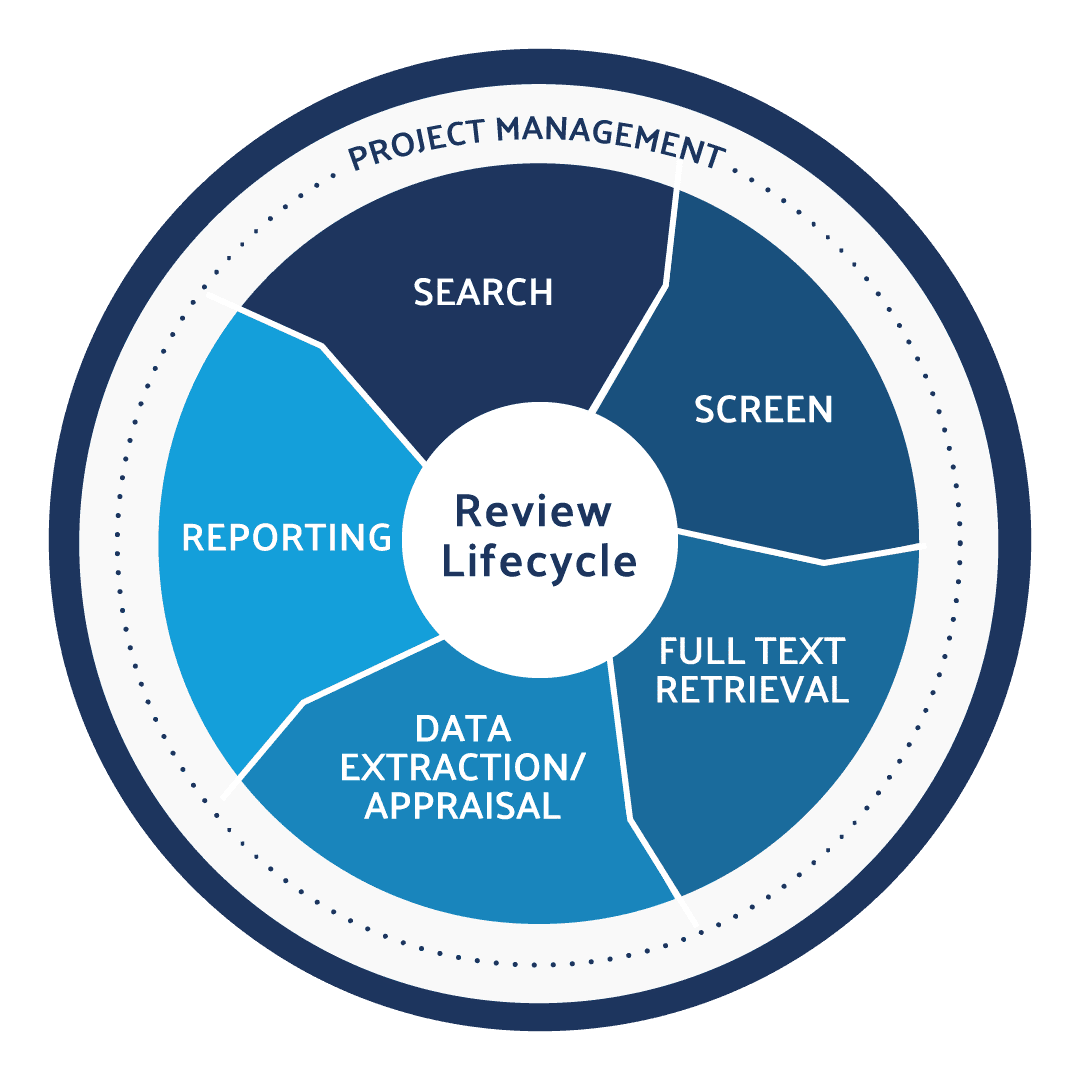
In more advanced forms (e.g., systematic reviews), the aim extends to comprehensive, transparent, and reproducible evidence synthesis to answer a narrowly defined research question (Elsevier Author Services - Articles).
The PRISMA framework standardises how systematic reviews are conducted and reported, ensuring methodological transparency and replicability (Page et al. 2021).
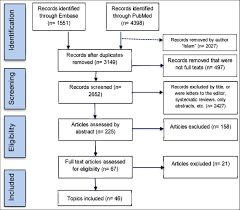
While PRISMA is primarily a reporting guideline, it reflects a widely adopted workflow comprising four core phases:
Output: Initial pool of studies
Output: Reduced set of potentially relevant studies
Output: Final set of eligible studies
Output: Evidence base for synthesis
PRISMA also includes a 27-item checklist covering reporting elements such as search strategy transparency, risk of bias assessment, and data synthesis procedures (Page et al. 2021).
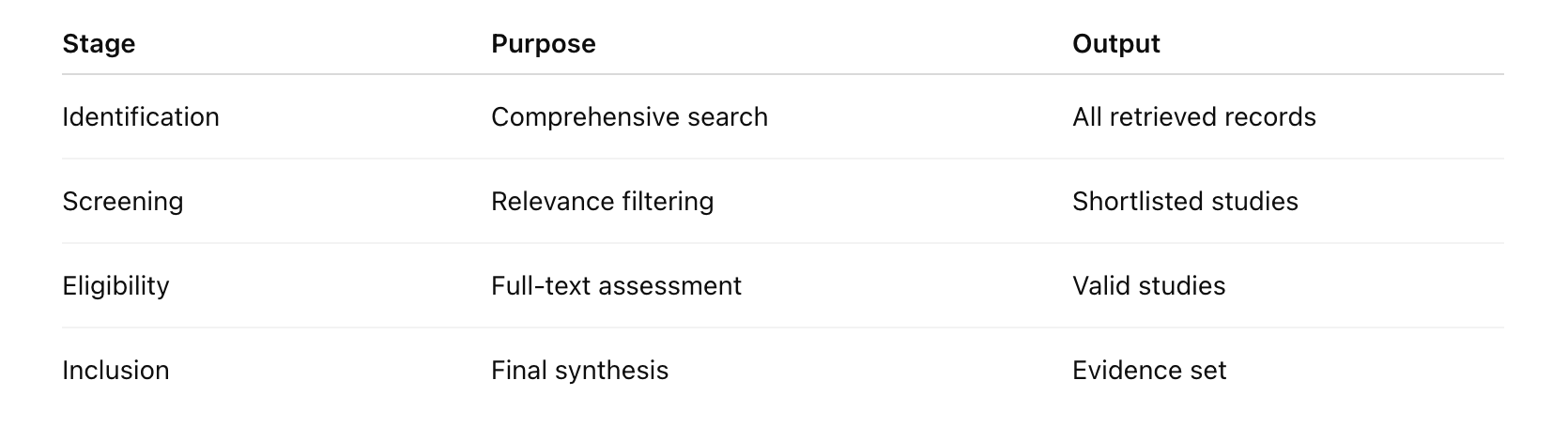
While the core logic of literature reviewing remains consistent, its purpose, scope, and epistemic expectations vary significantly across levels.
Primary aim: Knowledge familiarisation
At this level, literature reviews are typically introductory and pedagogical. The emphasis is on:
Criticality is limited; synthesis is often descriptive rather than analytical. The review functions as a learning exercise, not a contribution to knowledge.
Primary aim: Structured understanding and early critical thinking
Undergraduate literature reviews introduce:
The review begins to move beyond summary toward analytical synthesis, but remains constrained in scope and methodological rigour. It supports assignments, essays, or capstone projects rather than original research.
Primary aim: Knowledge production and research positioning
At postgraduate level, the literature review becomes central to scholarly work:
Doctoral-level reviews, in particular, must demonstrate originality and authority, often functioning as a standalone scholarly contribution. In systematic or scoping reviews, methodological transparency and reproducibility become essential (Australian National University).
Primary aim: Evidence-informed decision-making
In HRD and organisational settings, literature reviews are applied rather than purely academic:
The emphasis is on utility, relevance, and timeliness, often prioritising actionable insights over exhaustive coverage. Reviews may be rapid, narrative, or integrative rather than fully systematic.
AI tools (including large language models) can assist with literature reviews but exhibit structural constraints that limit their reliability for rigorous academic work:
Most scholarly articles are behind subscription barriers (e.g., Elsevier, JSTOR), limiting AI’s ability to retrieve full-text evidence.
AI systems do not systematically search proprietary databases (e.g., Scopus, Web of Science), undermining comprehensiveness—critical for systematic reviews.
Unlike formal review protocols (e.g., PRISMA), AI outputs do not document search strategies, inclusion criteria, or screening processes.
AI may generate plausible but non-existent citations or misattribute findings.
While AI can summarise, it struggles with nuanced evaluation of methodological quality, bias, or epistemological assumptions.
Models may not include the most recent publications unless explicitly connected to live retrieval systems.
AI tends toward thematic aggregation rather than deep theoretical integration or original critique.
Outputs may reflect publication bias or dominant paradigms embedded in training corpora.
The literature review is a context-sensitive scholarly instrument: its aims evolve from knowledge acquisition (school) to analytical synthesis (undergraduate), to epistemic contribution (postgraduate), and finally to evidence-based application (HRD). While AI can accelerate aspects of the review process, its limitations—particularly around access, transparency, and critical evaluation—mean it cannot yet substitute for rigorous, human-led scholarship.
Australian National University (ANU) 2020, Systematic literature reviews, ANU, viewed 2026. (Australian National University)
Booth, A, Sutton, A & Papaioannou, D 2016, Systematic approaches to a successful literature review, 2nd edn, Sage, London.
Deakin University 2024, Literature review, Deakin University, viewed 2026. (Deakin University)
DistillerSR 2024, Understanding the differences between a systematic review vs literature review, viewed 2026. (DistillerSR)
Elsevier 2022, Systematic literature review or literature review?, viewed 2026. (Elsevier Author Services - Articles)
Monash University 2024, Literature and systematic reviews, viewed 2026. (Monash University)
Omullah, H.K., 2025, Systematic reviews vs literature reviews: A comprehensive guide, viewed 2026. (ResearchGate)
Page, MJ, McKenzie, JE, Bossuyt, PM, Boutron, I, Hoffmann, TC, Mulrow, CD, et al. 2021, ‘The PRISMA 2020 statement: an updated guideline for reporting systematic reviews’, BMJ, vol. 372, n71.
Snyder, H 2019, ‘Literature review as a research methodology: An overview and guidelines’, Journal of Business Research, vol. 104, pp. 333–339.
Zarei M., 2025, Literature review and systematic review: What you need to know, viewed 2026. (Litmaps)


.png)


