

The Rational Decision-Making Model offers a disciplined approach to decision-making that prioritises logic, transparency, and consistency.

In complex professional and academic environments, decision-making is rarely intuitive or spontaneous. Instead, it benefits from a structured, transparent, and repeatable methodology. The Rational Decision-Making Model provides such a framework, guiding individuals through a sequence of logically ordered steps designed to optimise outcomes. This model is particularly valuable in contexts where accountability, evidence, and defensibility are required (Robbins and Judge, 2017; Bazerman and Moore, 2013).
This blog outlines the eight key steps in the Rational Decision-Making Model and explains how each contributes to rigorous, high-quality decisions.
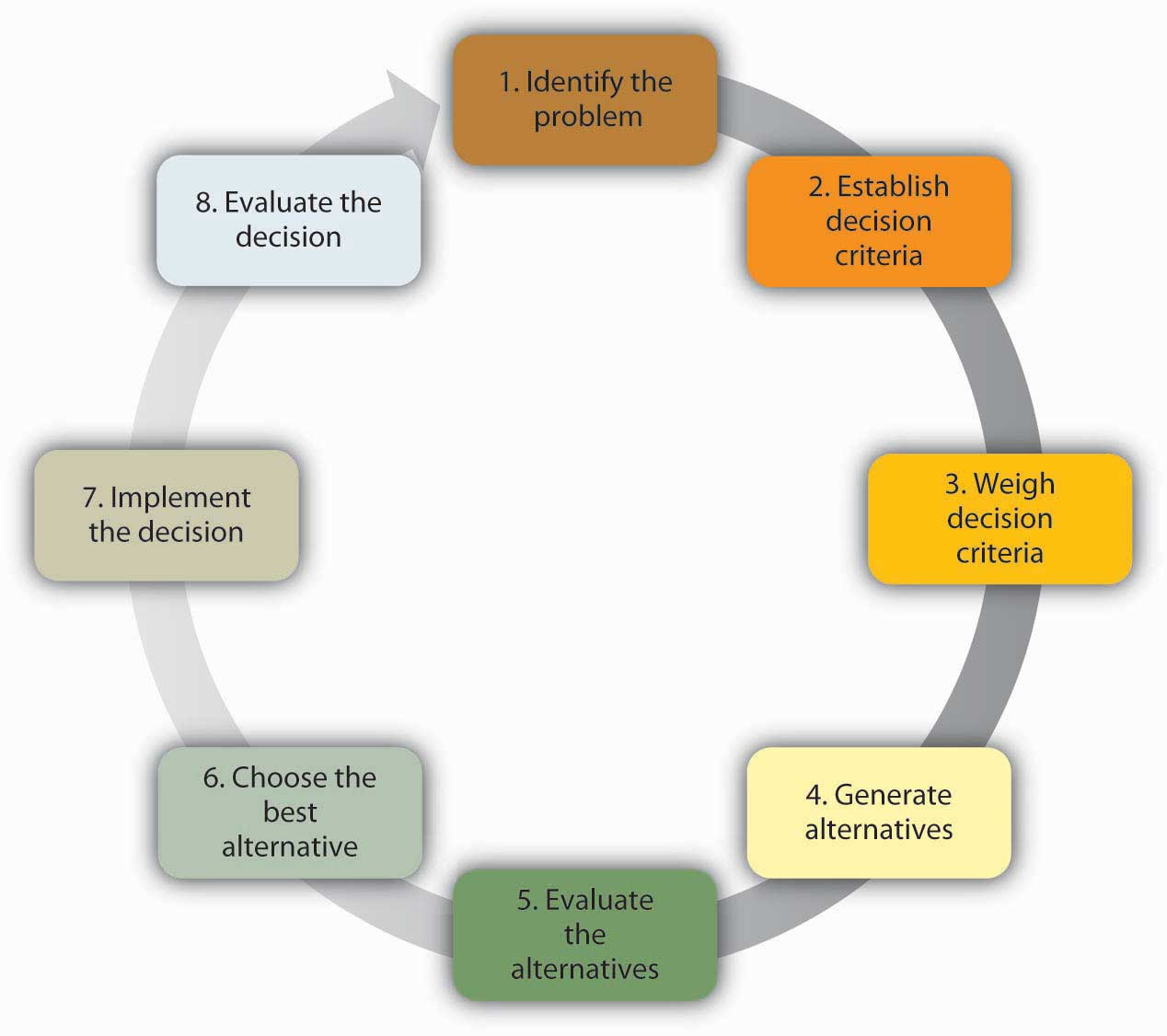
The process begins with precise problem definition. A poorly defined problem leads to misdirected analysis and ineffective solutions. At this stage, decision-makers must distinguish between symptoms and root causes (Simon, 1977).
Key considerations include:
Clarity here establishes the foundation for all subsequent steps.
Decision criteria are the factors that will influence the selection of a solution. These may include cost, time, quality, risk, feasibility, and alignment with strategic objectives (Hammond, Keeney and Raiffa, 1999).
This step requires:
Well-defined criteria ensure that decisions are aligned with organisational or personal priorities.
Not all criteria carry equal importance. Weighting assigns relative significance to each factor, enabling a more nuanced evaluation of alternatives (Saaty, 2008).
For example:
This introduces a formal prioritisation mechanism, reducing subjective bias in later stages.
At this stage, decision-makers generate a range of possible solutions. The objective is breadth before depth—ensuring that viable options are not prematurely excluded (Osborn, 1953).
Effective techniques include:
A narrow set of alternatives limits decision quality, so creativity and openness are essential here.
Each alternative is evaluated against the established criteria and their respective weights. This often involves constructing decision matrices or scoring models (Clemen and Reilly, 2014).
Analytical approaches may include:
The goal is to systematically compare options rather than rely on intuition.
Based on the analysis, the optimal solution is chosen. In a rational model, this is the alternative that achieves the highest overall score relative to the weighted criteria (Robbins and Judge, 2017).
However, decision-makers should also consider:
The “best” option is not only analytically superior but also contextually viable.
A decision has no value unless it is effectively executed. Implementation requires planning, resource allocation, communication, and monitoring (Kotter, 1996).
Critical elements include:
Execution transforms abstract decisions into tangible outcomes.
The final step involves assessing the outcomes against the original objectives. This closes the feedback loop and supports organisational learning (Argyris and Schön, 1978).
Evaluation should address:
Continuous improvement depends on systematic reflection and evidence-based evaluation.
The Rational Decision-Making Model offers a disciplined approach to decision-making that prioritises logic, transparency, and consistency. While real-world constraints—such as time pressure, incomplete information, and cognitive bias—may limit perfect rationality, this model provides a valuable benchmark (Simon, 1977; Bazerman and Moore, 2013).
By rigorously applying these eight steps, individuals and organisations can improve both the quality of their decisions and their ability to justify them in academic, professional, and governance contexts.
Argyris, C. and Schön, D.A. (1978) Organizational Learning: A Theory of Action Perspective. Reading, MA: Addison-Wesley.
Bazerman, M.H. and Moore, D.A. (2013) Judgment in Managerial Decision Making. 8th edn. Hoboken, NJ: Wiley.
Clemen, R.T. and Reilly, T. (2014) Making Hard Decisions with DecisionTools. 3rd edn. Stamford, CT: Cengage Learning.
Hammond, J.S., Keeney, R.L. and Raiffa, H. (1999) Smart Choices: A Practical Guide to Making Better Decisions. Boston: Harvard Business School Press.
Kotter, J.P. (1996) Leading Change. Boston: Harvard Business School Press.
Osborn, A.F. (1953) Applied Imagination: Principles and Procedures of Creative Thinking. New York: Scribner.
Robbins, S.P. and Judge, T.A. (2017) Organizational Behavior. 17th edn. Harlow: Pearson.
Saaty, T.L. (2008) ‘Decision making with the analytic hierarchy process’, International Journal of Services Sciences, 1(1), pp. 83–98.
Simon, H.A. (1977) The New Science of Management Decision. Englewood Cliffs, NJ: Prentice Hall.


.png)


