

Critical thinking is not only the ability to analyse information but also the ability to communicate reasoning clearly and logically.

Critical thinking is widely regarded as a foundational capability in higher education and professional knowledge work. It involves analysing information, evaluating evidence, constructing reasoned arguments, and communicating conclusions clearly. In academic contexts, one of the most persistent challenges students face is translating critical thought into structured written argument. Mnemonic frameworks such as OREO, PREP, PEER, and TEEL function as cognitive scaffolds that help writers organise reasoning into coherent argumentative structures.
These frameworks are particularly useful for novice academic writers because they externalise the structure of reasoning: a claim is presented, supported with evidence, explained logically, and tied back to the overall argument. Over time, repeated use of such frameworks internalises disciplined reasoning patterns that are characteristic of critical thinking.
Critical thinking refers to the disciplined process of conceptualising, analysing, synthesising, and evaluating information in order to guide belief or action (Facione, 1990). In academic writing, critical thinking manifests through:
However, many students struggle not with understanding ideas but with structuring arguments coherently. Mnemonic models address this gap by providing a repeatable reasoning template.
Educational researchers note that structured argument models help novice writers manage cognitive load by separating argument construction into discrete steps (Sweller, 1988; Wingate, 2012). Mnemonics therefore act as metacognitive tools that guide reasoning and communication simultaneously.
The OREO model is often introduced in secondary education as an accessible framework for persuasive writing.
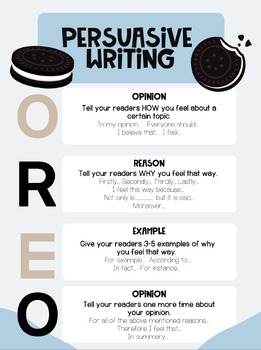
Structure
Example
Renewable energy investment should increase because it reduces long-term energy costs. Studies show that solar and wind energy have significantly declining production costs globally. Therefore, expanding renewable energy infrastructure is economically and environmentally beneficial.
Benefits
OREO is particularly effective in introductory academic writing, school essays, and persuasive paragraphs.
The PREP framework is widely used in professional communication and debate training.
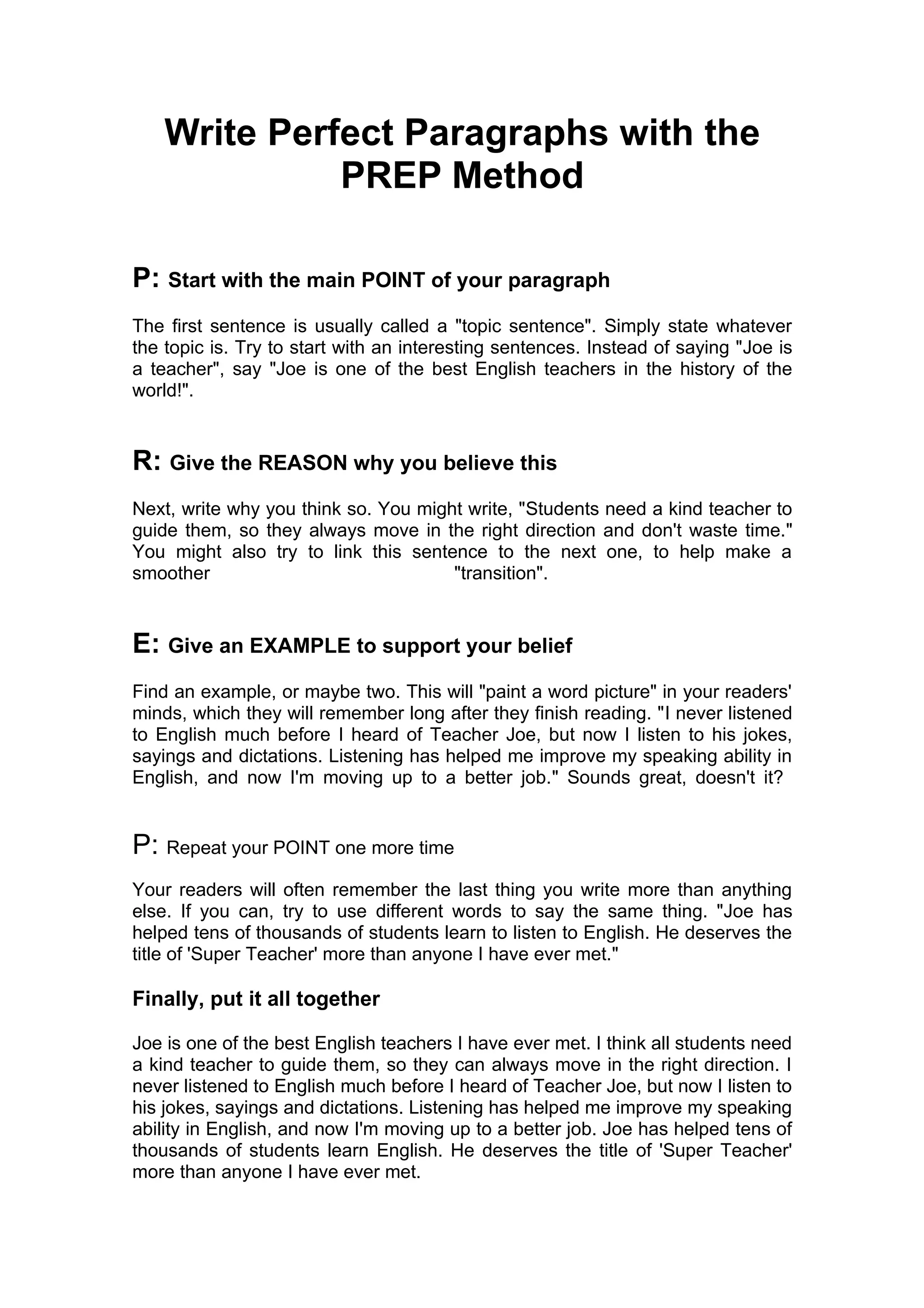
Structure
Example
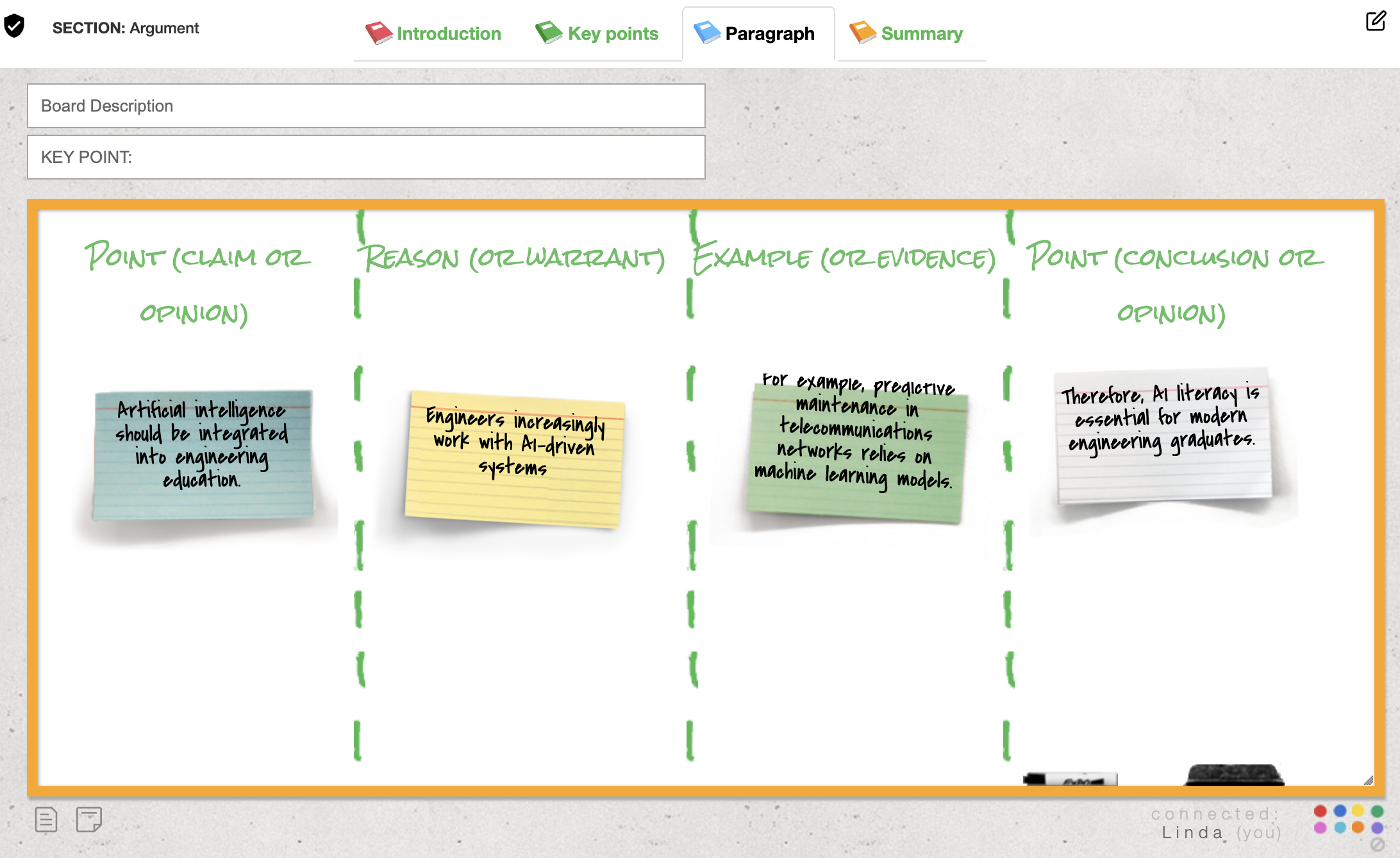
Artificial intelligence should be integrated into engineering education. Engineers increasingly work with AI-driven systems. For example, predictive maintenance in telecommunications networks relies on machine learning models. Therefore, AI literacy is essential for modern engineering graduates.
Benefits
Compared with OREO, PREP tends to be used in professional and oral contexts.
The PEER model emphasises analytical explanation rather than simple persuasion.
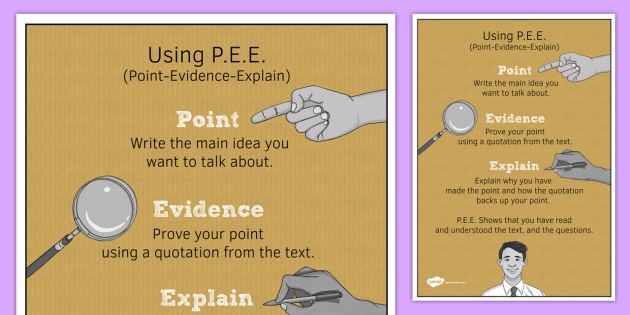
Structure: PEER
Example
Digital asset management systems improve research productivity. Studies show that scholars spend significant time searching for previously collected information (Jones, 2007). By organising research materials with structured metadata, DAM systems reduce retrieval time and improve knowledge reuse. Consequently, structured repositories support more efficient scholarly workflows.
Benefits
PEER is particularly valuable for teaching the distinction between evidence and explanation, a core element of critical thinking.
The TEEL structure is widely taught in Australian and UK secondary education.

Structure
Example
Structured argument frameworks support critical thinking in academic writing. Research in writing pedagogy shows that explicit rhetorical structures improve student reasoning (Wingate, 2012). When students follow structured models such as TEEL, they learn to connect evidence with explanation systematically. As a result, their essays demonstrate clearer logical progression.
Benefits
TEEL is especially useful for analytical essays and examination responses.
Although these mnemonic frameworks appear similar, they emphasise different aspects of reasoning.

All four models share a common logical pattern:
This pattern mirrors the classical rhetorical structure of argumentation described in logic and rhetoric literature (Toulmin, 1958).
The value of mnemonic reasoning frameworks lies in their ability to support metacognition and structured thinking.
Breaking argument construction into discrete steps reduces the mental effort required to organise ideas (Sweller, 1988).
Explicit reasoning structures encourage writers to justify claims with evidence and explanation, leading to stronger academic arguments (Wingate, 2012).
Once internalised, these frameworks help learners apply structured reasoning across disciplines including law, engineering, humanities, and management.
Mnemonic frameworks serve as instructional scaffolds that support learners until they develop more advanced rhetorical strategies (Vygotsky, 1978).
For researchers and knowledge professionals, mnemonic argument frameworks can also be integrated into note-taking systems, terminology libraries, and structured writing workflows. For example:
These practices reinforce critical thinking not merely as a cognitive skill but as a repeatable knowledge workflow.
Write.studio has a whiteboard canvas set up to facilitate capturing your thoughts and rearranging them into a logical argument. The whiteboard can be adapted to suit whichever mnemonic framework you choose to use.
Critical thinking is not only the ability to analyse information but also the ability to communicate reasoning clearly and logically. Mnemonic frameworks such as OREO, PREP, PEER, and TEEL provide practical scaffolding for constructing arguments, particularly for novice writers. By guiding writers through the essential steps of claim, evidence, explanation, and linkage, these models cultivate disciplined reasoning habits that underpin effective academic communication.
Over time, consistent use of such frameworks helps writers internalise structured argumentation, transforming mnemonic prompts into habitual patterns of critical thinking.
Facione, P.A. (1990) Critical Thinking: A Statement of Expert Consensus for Purposes of Educational Assessment and Instruction. Millbrae, CA: The Delphi Report.
Jones, W. (2007) ‘Personal information management’, Annual Review of Information Science and Technology, 41(1), pp. 453–504.
Sweller, J. (1988) ‘Cognitive load during problem solving: Effects on learning’, Cognitive Science, 12(2), pp. 257–285.
Toulmin, S. (1958) The Uses of Argument. Cambridge: Cambridge University Press.
Vygotsky, L.S. (1978) Mind in Society: The Development of Higher Psychological Processes. Cambridge, MA: Harvard University Press.
Wingate, U. (2012) ‘Using academic literacies and genre-based models for academic writing instruction’, Journal of English for Academic Purposes, 11(1), pp. 26–37.


.png)


