

Write.studio enables researchers to move from draft to publication-ready documents without switching tools, breaking formatting, or compromising academic standards; it represents a shift from AI-assisted writing to system-supported scholarship.

In the previous discussion, we established a clear pattern: AI is highly effective at accelerating academic writing, but consistently falls short in areas that matter most for publication—source reliability, formatting compliance, and dynamic document control.
This creates a structural gap in the academic writing workflow. Researchers can draft faster than ever, but still face friction when moving from AI-generated content to submission-ready manuscripts.
This is precisely the gap that Write.studio is designed to address.
Most AI writing platforms—whether assistive (e.g., Jenni) or generative (e.g., Samwell)—operate primarily at the text layer. They:
However, they do not solve three persistent problems:
Write.studio approaches academic writing differently—treating it as a system, not just a text-generation task.
AI tools often lack access to:
This leads to shallow synthesis and unreliable citations.
Write.studio integrates a built-in library that supports:
This fundamentally changes how AI operates within the platform:
The shift is from:
This directly addresses one of the most critical weaknesses in AI-assisted writing: epistemic reliability.
AI can mimic formatting, but cannot reliably enforce:
Formatting becomes fragile and inconsistent—especially in large manuscripts.
Write.studio introduces an independent style guide layer, which governs:
The style guide operates independent of the text itself enabling text refinment and reordering without causing any fractures to text.
Instead of embedding formatting into the writing process, Write.studio:
This aligns more closely with structured systems like JATS XML—but without requiring technical expertise.
As discussed previously, AI-generated numbering is static. It cannot:
This is a major risk in both journal articles and theses.
Write.studio includes a dynamic numbering engine that manages:
All numbering updates automatically as the document evolves.
This brings capabilities typically associated with:
into a unified, AI-supported environment.
The result is a document that remains structurally consistent and publication-ready, even after significant revisions.
Taken together, these features reposition AI within a complete academic writing system.
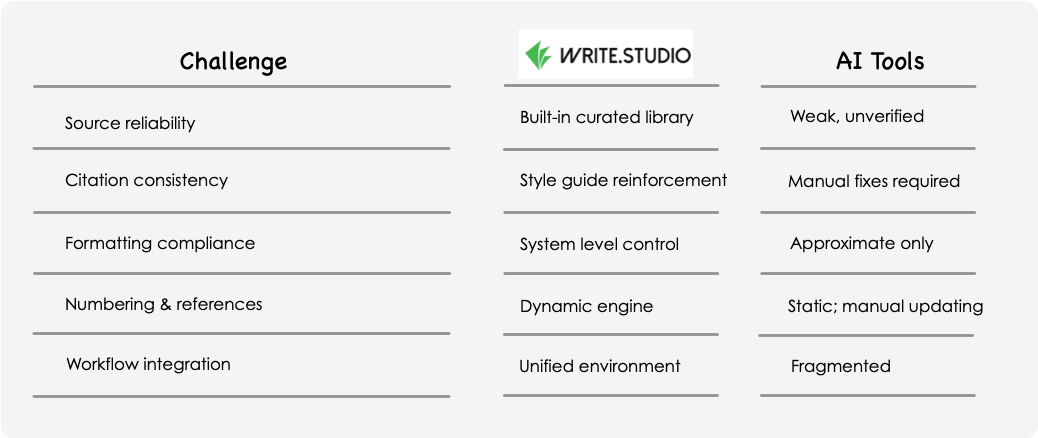
Write.studio enables:
Write.studio supports:
The key insight is this:
The limitation of AI in academic writing is not just about the quality of text—it is about the absence of systems that govern knowledge, structure, and formatting.
Write.studio addresses this by combining:
AI writing tools have matured rapidly, but they remain incomplete when used in isolation. They accelerate drafting, but do not ensure credibility, compliance, or consistency—all of which are essential for academic work.
Write.studio closes this gap by embedding AI within a structured, rule-governed environment. It does not replace the researcher, but it does something more valuable:
Write.studio enables researchers to move from draft to publication-ready document without switching tools, breaking formatting, or compromising academic standards.
In doing so, it represents a shift from AI-assisted writing to system-supported scholarship.


.png)


